

The New Blueprint
The New Blueprint: How AI Is Quietly Rewriting Real Estate Development
By CMI Market Intelligence — Special Investigation
For decades, project developers have operated in a paradox: the skylines grew taller, the budgets grew larger, and the materials became more advanced — yet the process of development remained stubbornly inefficient. A 15-story apartment building in 2025 still took roughly as long, required the same friction-filled coordination, and suffered the same cost unpredictability as it did in 2005. Some would argue 1995.
Despite trillions of dollars of asset value riding on the line, real estate development — especially in North America — resisted the kind of digital transformation that reshaped finance, manufacturing, logistics, and even agriculture. Project delays were chalked up to “normal risk.” Energy inefficiency was accepted as standard operating cost. Entitlement drag was viewed as an unavoidable byproduct of civic bureaucracy.
But in the past three years, something fundamentally different has emerged, quietly at first and now with unmistakable momentum. Artificial intelligence, machine learning, IoT sensors, robotics, and digital twins are no longer footnotes in PropTech demos. They are rewiring the economics of development from the moment a parcel is scouted to the day the building begins generating revenue.
Early adopters aren’t just experimenting — they’re outperforming. And the performance gap is widening fast.
As evidence mounts across U.S. and Mexican projects, the industry is waking up to a new reality:
The next competitive advantage in real estate isn’t land, capital, or design — it’s intelligence.
A Market Under Pressure — and Ripe for Disruption
Construction inflation in major U.S. markets has surged more than 40% since 2019, a shock that permanently altered underwriting models. Permitting delays lengthened. Contractor backlogs ballooned. Skilled labor shortages pushed wages to historic highs. And supply chain volatility turned procurement into an exercise in improvisation.
Developers long treated these issues as weather patterns: uncontrollable, unpredictable, and external. But the cumulative drag on project economics has become too large to ignore. Industry analysts estimate that inefficiencies — not market forces — account for 30–50% of cost overruns on major developments.
The inefficiency stack is well-documented:
Rework and change orders driven by miscoordination
Energy waste from buildings that never perform as modeled
Permitting cycles that drag for a year or more
Unit mix decisions made with incomplete or backward-looking data
Construction logistics managed manually across hundreds of trades and vendors
AI is not merely enhancing these processes. It’s re-architecting them.
Case Study 1 — Energy Optimization: Turning Buildings Into Learning Systems
Energy has traditionally been one of the least optimized and most expensive aspects of building operations. Mechanical systems run on generalized assumptions, not real behavior. HVAC reacts slowly. Faults go undetected. Tenant comfort is hard to measure. Until recently, these limitations were considered “the cost of doing business.”
In 2024, a Northeastern multi-residential tower decided to test this assumption by deploying an AI-driven building energy management system (BEMS). What happened next has rippled through the industry.
Within six months:
Electricity usage dropped by 42%
District cooling consumption fell by 24%
Carbon emissions fell by more than 400 tons
Payback period: just 2.3 months
This wasn’t a boutique building with bespoke engineering. It was an ordinary tower made intelligent through software.
And this pattern is repeating. Portfolio operators report:
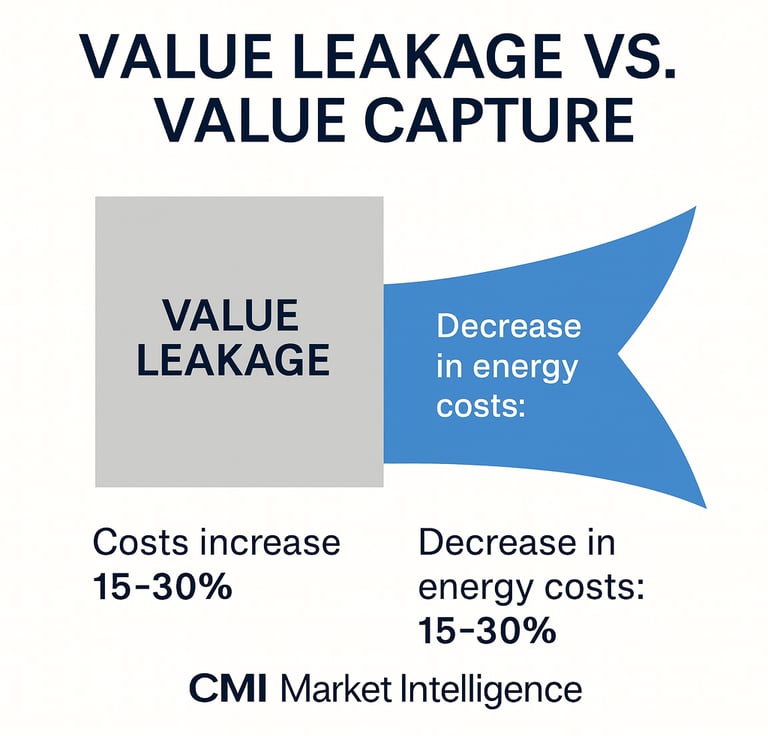
15–30% energy cost reductions
20–40% HVAC uptime improvements
Significant gains in tenant comfort and complaint reduction
These aren’t ESG headlines — they are NOI accelerators. Buildings using AI-optimized energy systems are posting millions in additional value at stabilization.
The message is clear:
Operations is no longer a cost center. With AI, it becomes a performance engine.
Case Study 2 — Construction: The Rise of AI-Driven Scheduling and Risk Modeling
Construction scheduling is one of the most complex puzzles in real estate: millions of variables, dozens of contractors, thousands of dependencies, and enormous risk exposure. Traditionally, schedules are crafted manually, relying on experience and intuition — and they drift almost immediately.
AI has changed that. Tools like ALICE Technologies and nPlan ingest historical data, structural designs, procurement schedules, and sequencing logic to generate thousands of schedule permutations in hours.
During a major U.S. interstate rebuild, the contractor used ALICE to explore more than 6,000 construction sequences — something impossible for a human team.
The result:
$25 million in savings
17% faster delivery
Double-digit reduction in worker hours
Fewer conflicts in sequencing and procurement
In vertical development, AI now:
Predicts delay risk months ahead
Flags materials shortages weeks before they occur
Optimizes labor allocation in real time
Identifies critical path failures before they derail the project
Developers describe it as having “a superhuman scheduler who never sleeps.”
Case Study 3 — Entitlements: Plan Review Times Cut in Half
Every developer knows the anxiety of permit purgatory — the silent months where capital burns and nothing moves. In cities like Austin, Houston, Honolulu, and Los Angeles, AI-powered review tools are reducing that dead time dramatically.
New systems automatically scan plans for:
Code conflicts
Egress and life-safety gaps
Zoning inconsistencies
ADA violations
Sheet-to-sheet discrepancies
Early adopters report ~50% faster approval cycles, fewer resubmittals, and earlier detection of problematic conditions that traditionally emerge just weeks before groundbreaking.
One multifamily developer in Texas said the time savings alone cut more than $1.8 million in carry costs — an outcome that reshaped their underwriting standards.
If permitting delays are one of the industry’s most expensive inefficiencies, AI has just cracked open one of its highest-leverage opportunities.
Case Study 4 — Design Intelligence: Thousands of Iterations in Days
Developers often rely on intuition when choosing unit mixes, floor plan variations, or building massing. But intuition is vulnerable to bias — and expensive when wrong.
In 2025, a Midwestern developer used AI to explore over 2,000 building configuration scenarios for a proposed 40-story condo tower.
The AI modeled:
Sunlight hours
View premiums
Structural cost per bay
Mechanical system optimization
Market absorption curves
Zoning envelopes
Circulation efficiency
Price elasticity by floor
Seventy-two hours later, the developer had a fully optimized scheme:
9% more net sellable SF
23% faster projected absorption
$11.4 million in incremental value
A process that used to take half a year became an algorithmic sprint. The developer reached a better answer faster — and with greater certainty.
AI didn’t replace the architect; it augmented their intelligence.
Case Study 5 — Mexico’s Leap: Digital Twins and 3D Printing Break the Mold
Mexico’s development ecosystem is evolving under a different set of pressures — nearshoring, industrial expansion, and a growing middle class. But tight margins and unpredictable costs still challenge developers.
Digital twins and IoT are beginning to shift that equation.
A large mixed-use project in Mexico City deployed a synchronized digital twin with integrated sensors. The outcomes:
30–35% energy savings
18% reduction in materials waste
Avoidance of multiple disruptive system failures
In Tabasco, ICON and ÉCHALE introduced 3D-printed housing blocks powered by advanced robotics and AI planning tools. Construction time dropped up to 70%, with better structural consistency and lower labor demand.
Mexico is not gradually modernizing — it’s leapfrogging. With AI, developers who previously lacked access to advanced tools now operate at global standards.
Why This Matters: AI Is Becoming the Strategy, Not the Tool
Historically, the winners in real estate succeeded through:
Superior land positions
Stronger relationships with contractors
Access to cheaper or more flexible capital
Faster entitlements
Those advantages still matter — but they no longer guarantee victory.
The new differentiator is intelligence.
Intelligence shortens timelines.
Intelligence reduces waste.
Intelligence compounds returns.
The firms thriving in the AI era share three traits:
1. They collapse predevelopment timelines.
Faster feasibility → fewer missteps → lower carry → earlier revenue.
2. They treat energy as an investment class.
Every kilowatt saved increases NOI and valuation.
3. They build digital-first operating models.
Data becomes a permanent organizational asset, not a project byproduct.
The Coming Divide: AI-Integrated Developers vs. Legacy Operators
By 2027–2030, the market will fracture into two distinct classes:
The AI-Enabled
15–25% lower total delivery cost
Faster entitlements
Higher absorption
Lower carbon footprint
Better financing terms
Stronger exit valuations
The AI-Lagging
Recurring cost overruns
Higher energy and operations spend
Slower delivery cycles
Compressed margins
Weaker competitiveness in institutional markets
In the words of one private equity partner:
“AI isn’t an efficiency tool. It’s underwriting.”
The Next 10 Years: A Structural Transformation
0–3 Years
AI becomes standard in feasibility, underwriting, energy optimization, and early design.
3–5 Years
Digital twins become required for large-scale financing; AI-assisted permitting becomes state-level policy.
5–10 Years
Buildings begin operating semi-autonomously. Underwriting relies on live performance data rather than static pro formas. Entire districts synchronize through digital infrastructure.
Real estate stops being a static asset and becomes a continuously learning organism.
The Bottom Line: Intelligence Is the New Real Estate
Real estate is entering its first true intelligence revolution.
Not a PropTech wave.
Not a marketing gimmick.
A structural redefinition of how buildings are created, valued, and operated.
Developers who adopt AI will not simply build faster — they will build smarter, cheaper, and with greater precision.
Those who wait will watch the market reward intelligence and punish inertia.
Where AI Is Creating Measurable Lift: A Data-Backed Summary
These are not projections. They’re verified outcomes — and they’re accelerating.
Across markets, AI is generating quantifiable results


© 2025 CurveMind Inc. All rights reserved. CMI Market Intelligence is a division of CurveMind Inc.